

The Amazing Spider-Man
aka Spiderman
Rate this game
- Played
- A lot
In The Amazing Spider-Man, released in 1990, you do not simply punch muggers across Manhattan streets; you navigate a deadly movie studio full of puzzle switches and film props to rescue Mary Jane from Mysterio before midnight.
When Mysterio Turns a Film Studio into a Dealtrap
Most superhero releases from the early nineties pushed players straight into endless side-scrolling beatings, but this title took a deliberate sidestep. Mysterio has locked Mary Jane inside Rockwell Studios, leaving you to solve your way through room after room of environmental traps. According to lead developer Rick Yapp in period press coverage, standard brawling felt inadequate for a hero defined by Peter Parker's intellect, so the team pivoted toward elaborate room hazards.
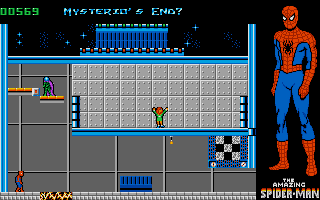
That choice shifts the weight of the entire experience onto screen navigation. Instead of clearing waves of thugs, you spend your time inspecting room layouts, flipping switches, manipulating levers, and turning off deadly energy barriers to unlock the next door. The studio lot is split into distinct movie set themes, ranging from Horror and Science Fiction sets to Westerns, Outer Space, Epics, Urban Adventure, Backstage, and Executive Offices.
The top-down awareness required by these flip-screen rooms makes every step calculated. You cannot simply rush into a set piece; a single wrong leap can drop you onto a bed of spikes or straight into the line of fire of an automated laser. If you prefer straightforward brawlers, this puzzle heavy structure can feel jarring, but it gives every set its own distinct mechanical identity.
Wall-Crawling, Web-Slinging, and the Physics of 256 Frames
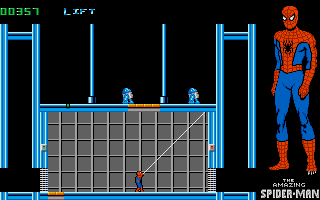
To bring Marvel's wall-crawler onto PC displays, programmers Kevin Ayre and John Wood built custom graphics tables capable of handling multi-directional surface crawling. The development team downscaled the main character sprite specifically so they could fit a 256-frame animation table into memory. That extra memory space allowed Spider-Man to transition cleanly between floor walking, vertical wall climbing, and inverted ceiling crawling.
When magazines like CU Amiga awarded the title 84% and Amiga Format gave it 77%, reviewers singled out that smooth character movement for praise. Watching the hero stick to a ceiling joist, flip over an obstacle, and drop behind an enemy remains visually satisfying. The sound options were equally tailored to the era's hardware, offering simple sound effects on a standard PC Speaker or richer synthesized audio for players with an AdLib card.
Yet that fluid visual display comes with a cost in responsiveness. The controls often feel heavy, and precision jumping demands exact timing that the sluggish input doesn't always deliver. Attempting to anchor a web line to a specific ceiling beam while dodging stage hazards can turn into an exercise in frustration, especially when the physics engine fails to register your intended angle of momentum.
Punishing Puzzles and a Skeleton on the Health Bar
The hazards inside Rockwell Studios are as absurd as they are constant. You encounter decorative film props turned lethal, including Frankenstein monsters, mummies, floating bats, and alien robots. While you can immobilize these foes temporarily using web-traps or attack them directly with punches and kicks, physical combat is secondary to survival.
Taking damage leads to one of the most memorable visual details in the game: the health gauge. Instead of a basic numerical bar, your health display features a portrait of Spider-Man that slowly degrades into a bare skeleton as you sustain damage. Watching your character turn to bone puts immediate pressure on every movement decision.
The game enforces its high difficulty through a strict save mechanism. You cannot save your progress directly to a hard drive or floppy disk mid-run; you can only store your current state in RAM at specific designated rooms. If you burn through your lives deep inside the studio, you start over. For players pushed to the brink by this setup, typing SPIDEY'S GONNA CHEAT! into the high score table refills your health meter whenever you hit the Enter key.
How The Amazing Spider-Man Compares to Other 1990 Releases
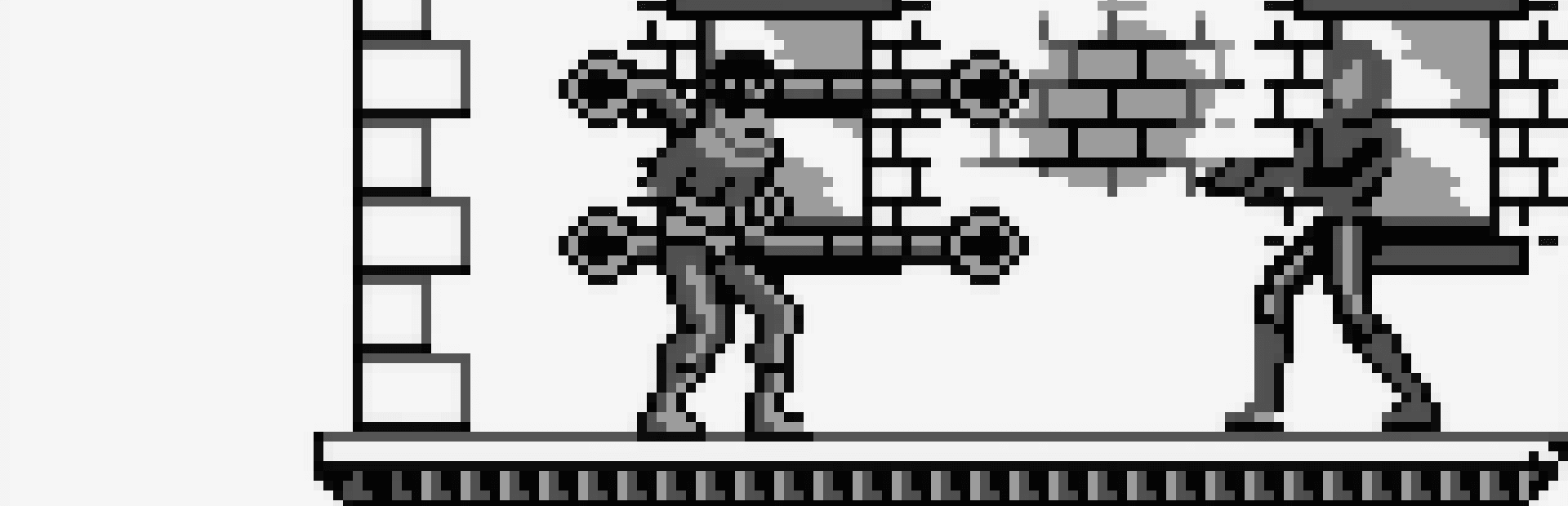
The year 1990 saw multiple adaptations of the comic franchise, including a handheld title from Rare on the Game Boy that focused strictly on linear action. By contrast, this MS-DOS release published by Paragon Software and designed in the UK by Oxford Digital Enterprises leaned entirely into room-by-room problem solving. It shares space in the catalog of 1990 releases alongside other experimental computer action games of the period, yet few pushed room navigation quite so hard.
Retail copies also included classic physical copy protection. Players had to consult the enclosed "Rockwell Studios Tour" manual to answer security checks before launching into the game, a standard anti-piracy hurdle for PC gamers at the turn of the decade.
Looking at the overall package today, the fluid character animations and creative studio themes hold up well, but the punishing trial-and-error screen layouts and stiff web-swinging controls take real patience to master. It is a fascinating piece of software for anyone curious about how developers tried to combine comic hero action with computer puzzle design.
Play The Amazing Spider-Man in Your Browser
If you want to experience Mysterio's trap-filled movie studio firsthand, you can play The Amazing Spider-Man online right now in your web browser. There is no software to install and no copy protection manual to flip through; just launch the game directly and start scaling walls.
Before you jump in, remember that web lines require careful placement, and flipping a switch often alters hazards several screens away. Keep an eye on that decaying health portrait, stick to the ceilings when the floor gets crowded, and keep the instant-health cheat code handy if Mysterio's stage props push you to the limit.
How The Amazing Spider-Man is played — the keys the game listens to, grouped by what they do.
- Movement
- Action
- Interface
- Other
Highlighted keys are mapped — hover or tap one to see what it does.
Game controls sourced from StrategyWiki documentation for the MS-DOS release.
Players' controls
Touch and gamepad controls
The on-screen keyboard and gamepad mapping the browser player uses on a phone, a tablet or a controller, as opposed to the real keys above. $PRO members make their own in the player and share them here; anyone can pick one to play with.
Make your own touch controlsPRO
- 1Open the editorSign in below, then pick what to make. The game starts with the editor open over it.
- 2Place your keysAdd keys and drag them where your thumbs rest, or map a controller's buttons. Test plays the game with them; Save keeps them, and you play with them from then on.
- 3Share themShare them right after saving in the game, or name and share them here. Players vote, and the best become this game's controls for everyone.
Go PROSee how it worksSign in+20 XP for sharing · +50 XP if yours become the game's own
- The game's own controlsKeyboardGamepadWhat every player starts with.In use
3 screenshots
From the archive
No gameplay video yet
No gameplay video for The Amazing Spider-Man yet. Sign in to add one.
No reviews yet
Tell the community what you think of The Amazing Spider-Man. Reviews are public and tied to your username.
No archived manuals for The Amazing Spider-Man yet
No manuals archived for this title yet. Sign in to upload the first scan.
Cheat codes, console commands and memory pokes for The Amazing Spider-Man — each one verified and attributed.
Sign in to submitNo cheats yet for this title
Know a working cheat, poke or trainer? Add it with the button above. Moderators check every entry before it goes live.
No archived soundtrack for The Amazing Spider-Man yet
No soundtrack archived for this title yet. Sign in to upload the first rip.
No save states for The Amazing Spider-Man yet
No save states for this title yet. Sign in to share one.
Discussions
Sign in to post- Threads0
- Total posts0
- Online now6
Community · The Amazing Spider-Man
Who's contributing, and what's new
- Reviews0
- Threads0
- Uploadsapproved0
- Contributors0
Recent activity