The Bard's Lore: The Warrior & The Dragon
aka The Bard's Lore I (The Warrior & The Dragon) · The Bard's Lore
Built with Interplay's construction kit, The Bard's Lore: The Warrior & The Dragon delivers a strict first-person party crawling experience straight out of the grid-mapper playbook. You assemble a crew in the city of Lorraine, report to the king for your quest, and immediately collide with a wall of custom monsters and punishing turns.
Custom monsters and shareware paywalls defined The Bard's Lore: The Warrior & The Dragon
Designing an entire dungeon crawler from scratch took immense effort in the nineties, which is why author John H. Wigforss turned to The Bard's Tale Construction Set. By utilizing Interplay's framework, Wigforss was able to skip coding basic rendering engines and focus entirely on level layouts, original narrative prompts, and customized combat statistics. The initial build circulated as a 1998 shareware release distributed through Homebrew / Freeware channels, offering players a substantial initial bite of turn-based dungeon crawling.
The original distribution scheme had a distinct financial hook. While the core game archive was freely shareable, essential companion files were locked behind a mail-in registration fee. If you wanted to read the complete spellbook or consult the official cluebook to clear late-game riddles, you had to register with the author directly. Registered users were also mailed an exclusive companion expansion titled The Bard's Lore II: The Dark Tower. Wigforss eventually lifted all restrictions in March 2002, releasing the complete package to the public at zero cost.
Starting in Lorraine means managing a frail party through unforgiving turns
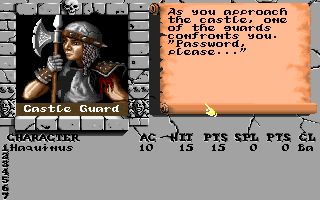
Your journey begins in the city of Lorraine, where the local king hands your party their overarching mission. Before stepping into danger, you must construct a balanced party across traditional adventuring archetypes. Frontline fighters take the brunt of physical damage, while back-row spellcasters supply long-range offensive magic and healing utility. Early survival hinges entirely on how efficiently you manage hit points and limited spell points across long expeditions between safe zones.
The early hours of this role-playing (RPG) game leave very little room for sloppy play. The combat encounter rate is tuned high, and enemy groups often outnumber your frontline warriors in the first few corridors. A sudden surprise attack can easily wipe out your primary healer before you get a chance to select a command. When a key party member drops in the field, you face a slow, dangerous retreat back through mapped corridors just to restore your roster.
Custom monsters and distinct spell rosters alter how familiar combat mechanics feel in practice. Wigforss swapped out standard enemy profiles for original beast configurations, forcing veterans of the construction engine to re-learn threat levels and targeting priorities on the fly. The list of features built into this adventure includes:
- Custom-authored monster groups with unique damage values and status inflictions
- Original puzzle structures that require solving positional clues and key locations
- A customized spellbook tailored specifically to the quest in Lorraine
- Full party creation using classic class setups and grid-based turn movement

Grid movement kept traditional computer RPG design alive on late-nineties PCs
By the late nineties, most mainstream studios had abandoned tile-based step movement in favor of fully textured real-time environments. Playing The Bard's Lore: The Warrior & The Dragon MS-DOS game in that era offered a deliberate alternative for players who preferred tactical, methodical exploration over quick reflexes. The step-by-step movement format gives you complete control over your pace, allowing you to carefully plan every move before stepping into an unmapped tile.
That rigid structural design demands precise bookkeeping from the player. Mapping out complex layouts requires paying close attention to wall textures, hidden doors, and teleporter traps that can instantly disorient an unobservant party. Without modern pathfinding markers or mini-maps cluttering the screen, keeping track of your exact coordinates becomes a core part of the challenge. I spent several sessions filling out physical grid notebook pages just to ensure my party could retreat safely from deep dungeon floors without getting lost in dark corridors.
Dungeon crawlers built by fans trade shiny visuals for pure tactical grit
As an independent construction kit project, the game relies heavily on solid mechanical balance rather than visual spectacle. The graphics rely entirely on the asset palette provided by Interplay's builder tool, meaning visual variety across dungeon sets can feel limited during long play sessions. However, the density of encounters and the strict resource management requirements keep the tension high throughout the quest.
The primary friction point today is the steep difficulty curve. Archives like the DOS Games Archive specifically flag the game as being pretty hard, and that reputation fits. The encounter tables do not scale gently to protect under-leveled parties, meaning a wrong turn into an advanced area will swiftly end your run. Success depends entirely on disciplined grinding, careful spell conservation, and frequent saves at safe locations.
Step into Lorraine and play The Bard's Lore: The Warrior & The Dragon online today
If you enjoy classic first-person party management, graph paper mapping, and turn-based combat built around strict rules, this project delivers an uncompromising retro experience. It strips away modern hand-holding in favor of hard-earned progression, forcing you to think carefully about every step you take through the streets of Lorraine and beyond. Players who appreciate the raw mechanical depth of early computer role-playing games will find plenty of grit to chew on here.
You can run The Bard's Lore: The Warrior & The Dragon free in your browser right now without needing to manage old installation files or set up custom system configurations. Start up the emulator, roll your initial party of adventurers at the tavern, and speak with the king to take your first steps out into the dangerous streets of Lorraine.