
The Bard's Tale II: The Destiny Knight
aka The Bard's Tale 2
Rate this game
- Played
- Rarely
In The Bard's Tale II: The Destiny Knight, developer Interplay Productions expanded the original dungeon crawler into a massive realm of six wilderness-linked cities, only to lock its late game behind some of the most unforgiving real-time death traps in 1980s computer role-playing.
Expanding Beyond Skara Brae into a Wider World
The core design of The Bard's Tale II: The Destiny Knight rests on a bold decision: take the tight grid mapping of the original game and drop it into a sprawling wilderness. Evil Archmage Lagoth Zanta has shattered the seven-segment Destiny Wand and hidden its pieces across the realm. Instead of staying confined to one city, your party of up to seven adventurers - built from races like elves, dwarves, hobbits, and half-orcs - traverses an overworld map connecting six different towns, including Tangramayne, to hunt down every fragment.
You can create a brand-new party or import veterans from the first game, as well as saved characters from competing series like Wizardry or Ultima III. That flexibility is a welcome touch, because the early hours demand every advantage you can muster. Exploring the first few dungeons, from the Tombs to Fanskar's Castle, means managing a squad of war-hardened fighters and fragile spellcasters who eventually must ascend to the rank of Archmage to wield the reassembled wand.
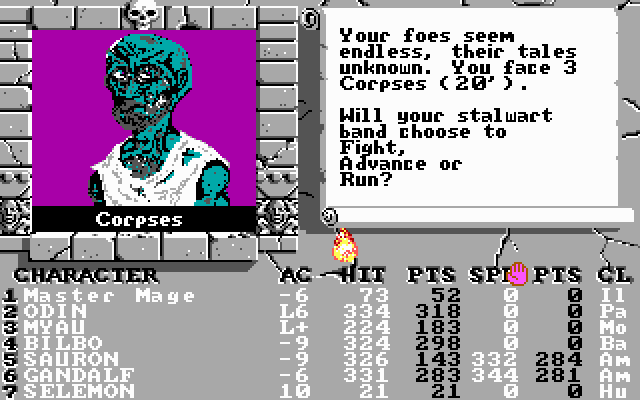
The top-down perspective of the wilderness travel flips quickly to a first-person view once you enter a city or a multi-level complex like Oscon's Fortress or the Maze of Dread. Navigating these spaces means dealing with random monster encounters in turn-based combat, managing spells, and hunting for vital gear like the Thieves Dagger or the Staff of War. The presentation relies on crisp step-by-step dungeon graphics and functional PC speaker audio, though running the game on period-appropriate Sound Blaster hardware gives its spell effects and combat cues a much meatier punch.
Death Snares, Grinding, and the Limits of 1988 PC Hardware
For all its expanded scope, this 1988 role-playing game hits players with severe difficulty spikes and mechanical frustrations. The game lacks an auto-map feature, throwing you into complex non-Euclidean mazes filled with magic-canceling anti-magic zones, permanent darkness, tile spinners that mess with your orientation, and magic mouth riddles that require exact text inputs. Getting stuck at the Sage because you did not type a recognized phrase like "Zen Master" or "Death Sword" happened to almost everyone who played it.
The most notorious elements in The Bard's Tale II: The Destiny Knight are the Death Snares located at the deep ends of dungeons. These real-time puzzle rooms disable all normal spellcasting, block saves, and run on strict real-time countdown clocks. Make a wrong move or fail to solve the riddle before time runs out, and your entire party is instantly wiped. The reliance on spellcasters leaves martial classes feeling underpowered, while party creation on the original MS-DOS version inexplicably omitted female character options that existed on other platforms.
One famous trick saved many players from throwing their floppy disks across the room: typing the spell code SCSI. It is the single spell capable of bypassing the game's strict anti-magic rules, letting desperate adventurers cast magic even within the heart of a Death Snare.
How The Bard's Tale II: The Destiny Knight Lands Today
At the time of release, critics held sharply divided views on the experience. Period magazine reviews praised the smoother onboarding, clearer city layouts, and the sheer depth of items and spells. Yet later retrospective reviews rightly criticized the trap placement as excessively tedious, with some writers calling out the dungeon layout as the most frustrating entry in the original trilogy. Despite the friction, it proved a massive commercial success for Electronic Arts and designer Michael Cranford, taking home an Origins Award for its scope.
Compared to rival 1988 releases like Pool of Radiance, which focused on tactical grid combat, this entry doubled down on punishing grid-mapping puzzles and raw party resource management. If you love pencil-and-paper mapping, severe consequences, and classic dungeon-crawling history, it is still a fascinating challenge to test your patience against.
You can play The Bard's Tale II: The Destiny Knight free in your browser right now, with no setup or local files required. If you want to jump straight into the action, start by exploring Tangramayne, gather your party in the local tavern, and keep graph paper handy for the dark corridors below.
How The Bard's Tale II: The Destiny Knight is played — the keys the game listens to, grouped by what they do.
- Movement
- Action
Highlighted keys are mapped — hover or tap one to see what it does.
Players type four-letter spell codes when casting spells. The documented mapping is incomplete based on the provided material.
Players' controls
Touch and gamepad controls
The on-screen keyboard and gamepad mapping the browser player uses on a phone, a tablet or a controller, as opposed to the real keys above. $PRO members make their own in the player and share them here; anyone can pick one to play with.
Make your own touch controlsPRO
- 1Open the editorSign in below, then pick what to make. The game starts with the editor open over it.
- 2Place your keysAdd keys and drag them where your thumbs rest, or map a controller's buttons. Test plays the game with them; Save keeps them, and you play with them from then on.
- 3Share themShare them right after saving in the game, or name and share them here. Players vote, and the best become this game's controls for everyone.
Go PROSee how it worksSign in+20 XP for sharing · +50 XP if yours become the game's own
- The game's own controlsKeyboardGamepadWhat every player starts with.In use
2 screenshots
From the archive
No gameplay video yet
No gameplay video for The Bard's Tale II: The Destiny Knight yet. Sign in to add one.
No reviews yet
Tell the community what you think of The Bard's Tale II: The Destiny Knight. Reviews are public and tied to your username.
No archived manuals for The Bard's Tale II: The Destiny Knight yet
No manuals archived for this title yet. Sign in to upload the first scan.
Cheat codes, console commands and memory pokes for The Bard's Tale II: The Destiny Knight — each one verified and attributed.
Sign in to submitNo cheats yet for this title
Know a working cheat, poke or trainer? Add it with the button above. Moderators check every entry before it goes live.
No archived soundtrack for The Bard's Tale II: The Destiny Knight yet
No soundtrack archived for this title yet. Sign in to upload the first rip.
No save states for The Bard's Tale II: The Destiny Knight yet
No save states for this title yet. Sign in to share one.
Discussions
Sign in to post- Threads0
- Total posts0
- Online now6
Community · The Bard's Tale II: The Destiny Knight
Who's contributing, and what's new
- Reviews0
- Threads0
- Uploadsapproved0
- Contributors0
Recent activity
Nothing here yet
Reviews, discussion threads and approved uploads appear here as members add them.