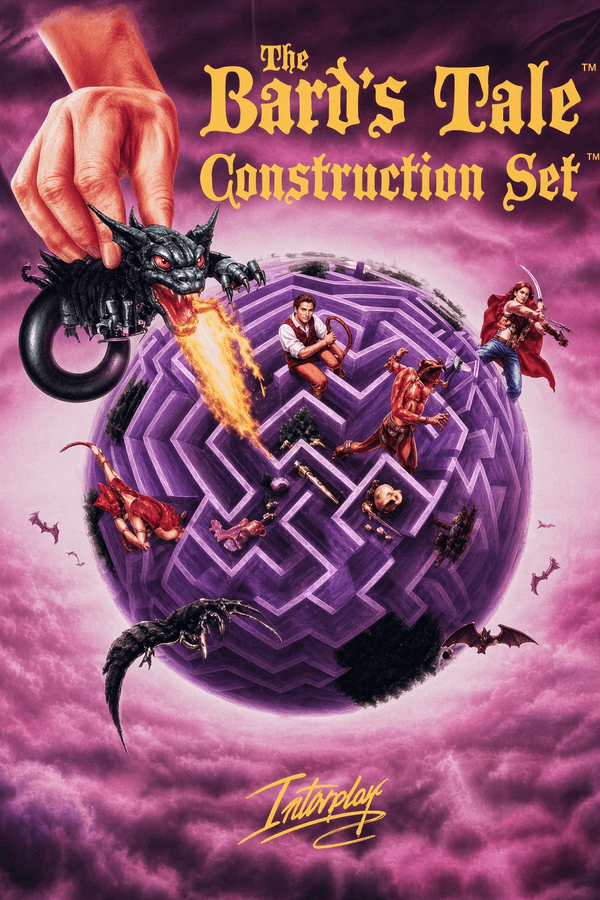
By shipping Interplay's internal engine directly to fans, The Bard's Tale Construction Set transformed one of the premier first-person dungeon crawlers of the DOS era into a sandbox for homebrew mapmakers.
In 1991, handing a player the key to a commercial role-playing engine was a bold experiment. Instead of merely offering a light map sketcher, this toolset provides full editor submenus for crafting original spells, shaping a custom bestiary, and tuning magic items ranging from simple potions to powerful swords. You assemble grid maps from tile assets pulled straight from the third entry in the series, dropping in classic RPG hazards like hidden doors, step-activated teleporters, anti-magic zones, and pitch-black pits.
The core design loop sits between top-down map layout and modular text triggers. You can place conditional events on specific coordinates, turning a blank dungeon grid into a sequence of puzzle doors, sudden ambushes, or scripted story encounters. If you want a door to open only after your party locates a specific key in a nearby crypt, the engine allows you to link those flags directly to map tiles. To speed up balance adjustments, the built-in monster editor even includes an automatic experience point calculator, bound to the F key or the "Find XP" menu option, which figures out reward values based on an enemy's stats and special abilities.
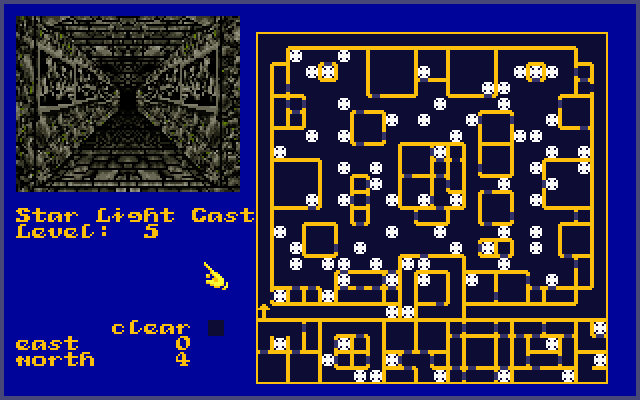
The developers packed in a full sample campaign titled Star Light Festival to demonstrate what the tools could do. Set in the run-down settlement of Isil Thania, your party uncovers a Star Cult across five zones: the Rainbow Bar, an underground wine cellar, sewers, the deep Undercity, and a final Crypt. Built by a team including Thomas R. Decker, Christopher R. Taylor, and Jim Gardner, these maps show how professional designers wired together map switches and encounter tables.
Unfortunately, playing through the sample scenario reveals a brutal pacing problem. Star Light Festival is notoriously imbalanced at the start, forcing fresh level-one parties to spend hours endlessly grinding basic fights inside the wine cellar just to survive the leap into the sewers. Technical quirks further complicate the experience: playing bard songs can occasionally trigger a crash straight back to the DOS prompt. For players looking to test their own level logic rather than grind through early combat steps, building a custom scenario often proves far more rewarding than tackling the provided campaign.
On the hardware side, this editor sits right at the transition point of early nineties PC gaming. Built on an upgraded version of The Bard's Tale III: Thief of Fate engine, the program was coded by a team that included a young Tim Cain alongside Greg Christensen and John Philip Britt, with future Black Isle Studios founder Feargus Urquhart handling playtesting duties. It supports standard VGA graphics alongside digitized audio effects for major sound devices of the time, so hearing a creature roar on a Sound Blaster card added real weight to custom encounters compared to standard PC speaker beeps. Creative designers could even import custom graphics from Deluxe Paint (DPaint) files to replace stock creature art.
Period reviews were sharply divided depending on the machine being tested. Dragon Magazine gave the package a glowing 5 out of 5 stars in issue #183, hailing it as a top-tier fantasy creation kit. Conversely, Computer Gaming World pointed out that while it was a solid dungeon editor, it arrived somewhat rough around the edges with a restricted selection of visual assets and offensive magic spells. UK magazines covering rival platforms were far harsher, calling out the rigid step-by-step combat and tile-bound movement as dated mechanics that felt stuck in the past.
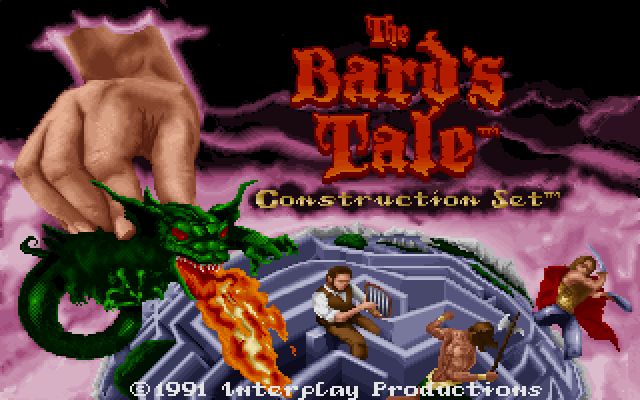
The main split between this package and standard level editors was its distribution model. Through a menu option, creators could compile their completed maps, custom spells, and monster tables into an independent, standalone executable. The manual highlighted that this generated BARDGAME.EXE file could be legally copied and shared with friends without requiring them to own the original construction kit.
That open approach to distribution gave the package a second life among PC hobbyists. Instead of just sharing map data files, creators could trade full, playable games on bulletin board systems. The user interface also included small quality-of-life shortcuts, such as using the + and - keys to alter menu text scrolling speeds while building out long conversation trees.
While the step-based movement and text-heavy menus definitely show their age, the core appeal of assembling your own first-person crawler remains surprisingly intact. If you enjoy the tactical cadence of classic turn-based role-playing games from 1991, tinkering with map triggers and monster balance here provides a fascinating peak into how early nineties RPGs were put together.
The easiest way to experience this piece of software today is right inside your web browser. You can play The Bard's Tale Construction Set free in your browser without downloading extra utilities or configuring virtual drives. Launching the MS-DOS game directly in your window lets you jump right into the sample adventure, test out the custom item builder, or start placing teleporters across a brand new dungeon grid within seconds.
By shipping Interplay's internal engine directly to fans, The Bard's Tale Construction Set transformed one of the premier first-person dungeon crawlers of the DOS era into a sandbox for homebrew mapmakers.
In 1991, handing a player the key to a commercial role-playing engine was a bold experiment. Instead of merely offering a light map sketcher, this toolset provides full editor submenus for crafting original spells, shaping a custom bestiary, and tuning magic items ranging from simple potions to powerful swords. You assemble grid maps from tile assets pulled straight from the third entry in the series, dropping in classic RPG hazards like hidden doors, step-activated teleporters, anti-magic zones, and pitch-black pits.
The core design loop sits between top-down map layout and modular text triggers. You can place conditional events on specific coordinates, turning a blank dungeon grid into a sequence of puzzle doors, sudden ambushes, or scripted story encounters. If you want a door to open only after your party locates a specific key in a nearby crypt, the engine allows you to link those flags directly to map tiles. To speed up balance adjustments, the built-in monster editor even includes an automatic experience point calculator, bound to the F key or the "Find XP" menu option, which figures out reward values based on an enemy's stats and special abilities.

The developers packed in a full sample campaign titled Star Light Festival to demonstrate what the tools could do. Set in the run-down settlement of Isil Thania, your party uncovers a Star Cult across five zones: the Rainbow Bar, an underground wine cellar, sewers, the deep Undercity, and a final Crypt. Built by a team including Thomas R. Decker, Christopher R. Taylor, and Jim Gardner, these maps show how professional designers wired together map switches and encounter tables.
Unfortunately, playing through the sample scenario reveals a brutal pacing problem. Star Light Festival is notoriously imbalanced at the start, forcing fresh level-one parties to spend hours endlessly grinding basic fights inside the wine cellar just to survive the leap into the sewers. Technical quirks further complicate the experience: playing bard songs can occasionally trigger a crash straight back to the DOS prompt. For players looking to test their own level logic rather than grind through early combat steps, building a custom scenario often proves far more rewarding than tackling the provided campaign.
On the hardware side, this editor sits right at the transition point of early nineties PC gaming. Built on an upgraded version of The Bard's Tale III: Thief of Fate engine, the program was coded by a team that included a young Tim Cain alongside Greg Christensen and John Philip Britt, with future Black Isle Studios founder Feargus Urquhart handling playtesting duties. It supports standard VGA graphics alongside digitized audio effects for major sound devices of the time, so hearing a creature roar on a Sound Blaster card added real weight to custom encounters compared to standard PC speaker beeps. Creative designers could even import custom graphics from Deluxe Paint (DPaint) files to replace stock creature art.
Period reviews were sharply divided depending on the machine being tested. Dragon Magazine gave the package a glowing 5 out of 5 stars in issue #183, hailing it as a top-tier fantasy creation kit. Conversely, Computer Gaming World pointed out that while it was a solid dungeon editor, it arrived somewhat rough around the edges with a restricted selection of visual assets and offensive magic spells. UK magazines covering rival platforms were far harsher, calling out the rigid step-by-step combat and tile-bound movement as dated mechanics that felt stuck in the past.

The main split between this package and standard level editors was its distribution model. Through a menu option, creators could compile their completed maps, custom spells, and monster tables into an independent, standalone executable. The manual highlighted that this generated BARDGAME.EXE file could be legally copied and shared with friends without requiring them to own the original construction kit.
That open approach to distribution gave the package a second life among PC hobbyists. Instead of just sharing map data files, creators could trade full, playable games on bulletin board systems. The user interface also included small quality-of-life shortcuts, such as using the + and - keys to alter menu text scrolling speeds while building out long conversation trees.
While the step-based movement and text-heavy menus definitely show their age, the core appeal of assembling your own first-person crawler remains surprisingly intact. If you enjoy the tactical cadence of classic turn-based role-playing games from 1991, tinkering with map triggers and monster balance here provides a fascinating peak into how early nineties RPGs were put together.
The easiest way to experience this piece of software today is right inside your web browser. You can play The Bard's Tale Construction Set free in your browser without downloading extra utilities or configuring virtual drives. Launching the MS-DOS game directly in your window lets you jump right into the sample adventure, test out the custom item builder, or start placing teleporters across a brand new dungeon grid within seconds.

How The Bard's Tale Construction Set is played — the keys the game listens to, grouped by what they do.
Highlighted keys are mapped — hover or tap one to see what it does.
The on-screen keyboard and gamepad mapping the browser player uses on a phone, a tablet or a controller, as opposed to the real keys above. $PRO members make their own in the player and share them here; anyone can pick one to play with.
Cheat codes, console commands and memory pokes for The Bard's Tale Construction Set — each one verified and attributed.
Sign in to submit
The Bard's Tale Construction Set1991 · this pageCheat codes, console commands and memory pokes for The Bard's Tale Construction Set — each one verified and attributed.
Sign in to submit
The Bard's Tale Construction Set1991 · this page