
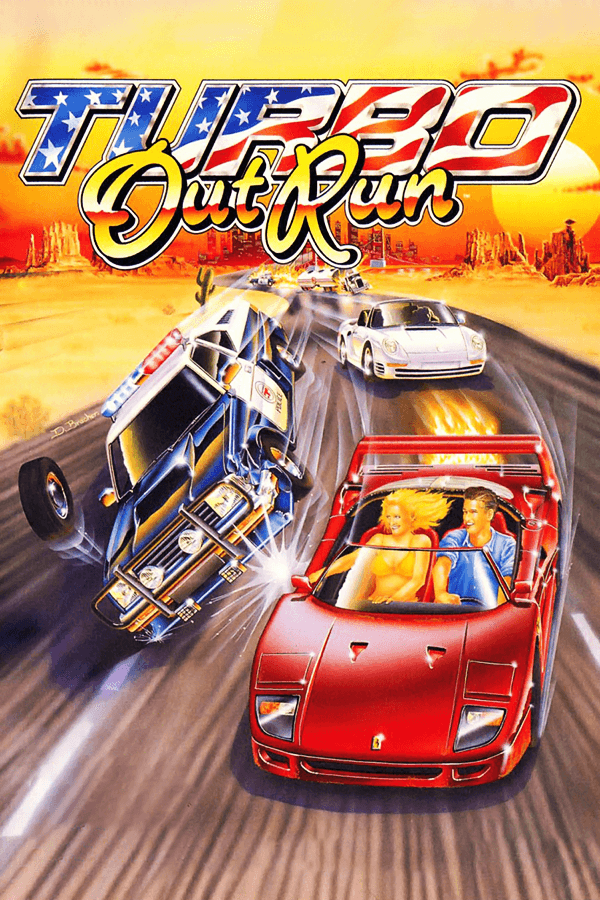

Turbo Out Run
aka Turbo OutRun · ターボアウトラン
Rate this game
If you hit the boost button in Turbo Out Run without watching your engine heat, your car stalls out long before you see California. Sega AM2 dropped the branching paths of the first game for a straight coast-to-coast drag race against a stubborn computer opponent.
Trading branching roads for a high-speed sprint across America
The original arcade trip through scenic forks in the road gives way to a linear 16-stage sprint across the United States. You start in New York City and push west toward Los Angeles, tackling four distinct regions divided into four stages each. Instead of selecting your own route at every junction, you follow a set course that tests your nerve against a strict timer.
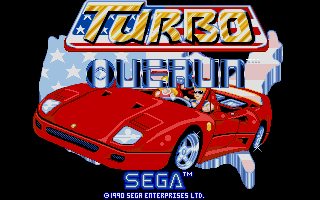
You drive a red Ferrari F40, but you are not alone on the highway. A white Porsche 959 drives alongside you as your main rival throughout the entire trip. If that Porsche reaches the checkpoint at the end of a four-stage section before you do, your female passenger jumps ship to ride with your rival instead. Winning that checkpoint gets her back, giving you a immediate reason to keep your foot down.
The headline addition is the manual boost button. Slapping the boost pushes your speed past normal limits, but overusing it overheats the engine instantly. Once the temperature gauge hits max, your turbo disables itself until the system cools down. Managing that heat spike while dodging oncoming traffic is where the core challenge lives.
What happens to Turbo Out Run on a home PC
The original arcade cabinet ran on custom dual-68000 hardware that scaled sprites with silky smoothness. When U.S. Gold published this port on PC in 1989, the developers had to write custom software pseudo-3D routines from scratch for standard home computers. The result on DOS is a mixed bag that looks much rougher than the machine in the arcade.
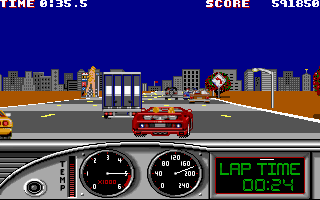
Where the arcade cabinet dazzled players with rich sound hardware and synth tracks from Hiroshi Kawaguchi and Yasuhiro Takagi, the MS-DOS release relies heavily on simple internal speakers or early sound boards. Depending on your vintage audio card setup, the music either sounds thin or gets replaced entirely by engine hums and tire squeals. That difference in presentation caught many PC players off guard at the time.
Frame rates on MS-DOS hardware can drop dramatically when multiple cars populate the screen. On modern computer setups and emulators, players frequently complain about severe screen flickering unless the CPU cycles are manually set to automatic in DOSBox. It feels like a software conversion built under a deadline rather than a tailor-made PC driving engine.
Upgrades, bad weather, and a quick pit stop
Every four stages, the action breaks for a garage tune-up screen. This pit stop lets you select specialized car upgrades to prepare for the next leg of the trip. Choosing the right part alters how your car handles the hazards waiting ahead on the blacktop.
You can equip your car with three primary types of enhancements:
- High-grip tires to reduce slide on slick asphalt and sharp turns.
- Special engine upgrades that raise your baseline top speed without using boost.
- Turbochargers to increase the raw acceleration boost when activated.
You will need those upgrades because the road conditions get progressively meaner. Police cruisers active in certain stages attempt to pull you over, ramming your rear bumper to drain your precious seconds. Rainstorms slick the pavement, while oil spills lying in the middle of tight corners send your Ferrari spinning out of control.
Crashing into barriers, roadside objects, or traffic causes your car to roll or spin out completely. Every second spent recovering on the shoulder bleeds your remaining time. You receive five continues to complete the entire cross-country drive, so a couple of bad crashes in the later stages can bring your run to a sudden end.
The verdict on this DOS translation
For fans who grew up with original arcade hardware designed by Sega AM2, the home computer port of Turbo Out Run can feel unrefined. The software sprite scaling suffers from choppy animation, and the sense of extreme speed is muted compared to the original arcade cabinet. Yet, as a straightforward computer racing game from its era, the core mechanic of managing your boost temperature still provides real tension.
The upgrade system adds a layer of strategy that the original game lacked. Balancing when to dump your turbo heat on a long straightaway versus keeping it cool for police encounters creates a good rhythm. It is not the cleanest port, but it shows exactly how home systems wrestled with heavy arcade hardware.
You can play Turbo Out Run online for free in your browser right now without downloading extra tools. Fire up the engine, manage your boost gauge, and see if you can keep your passenger from jumping into that Porsche.
Players' controls
Touch and gamepad controls
The on-screen keyboard and gamepad mapping the browser player uses on a phone, a tablet or a controller, as opposed to the real keys above. $PRO members make their own in the player and share them here; anyone can pick one to play with.
Make your own touch controlsPRO
- 1Open the editorSign in below, then pick what to make. The game starts with the editor open over it.
- 2Place your keysAdd keys and drag them where your thumbs rest, or map a controller's buttons. Test plays the game with them; Save keeps them, and you play with them from then on.
- 3Share themShare them right after saving in the game, or name and share them here. Players vote, and the best become this game's controls for everyone.
Go PROSee how it worksSign in+20 XP for sharing · +50 XP if yours become the game's own
- The game's own controlsNone yet: played with a real keyboard only.In use
2 screenshots
From the archive
No gameplay video yet
No gameplay video for Turbo Out Run yet. Sign in to add one.
No reviews yet
Tell the community what you think of Turbo Out Run. Reviews are public and tied to your username.
No archived manuals for Turbo Out Run yet
No manuals archived for this title yet. Sign in to upload the first scan.
Cheat codes, console commands and memory pokes for Turbo Out Run — each one verified and attributed.
Sign in to submitNo cheats yet for this title
Know a working cheat, poke or trainer? Add it with the button above. Moderators check every entry before it goes live.
No archived soundtrack for Turbo Out Run yet
No soundtrack archived for this title yet. Sign in to upload the first rip.
No save states for Turbo Out Run yet
No save states for this title yet. Sign in to share one.
Discussions
Sign in to post- Threads0
- Total posts0
- Online now6
Community · Turbo Out Run
Who's contributing, and what's new
- Reviews0
- Threads0
- Uploadsapproved0
- Contributors0
Recent activity
Nothing here yet
Reviews, discussion threads and approved uploads appear here as members add them.