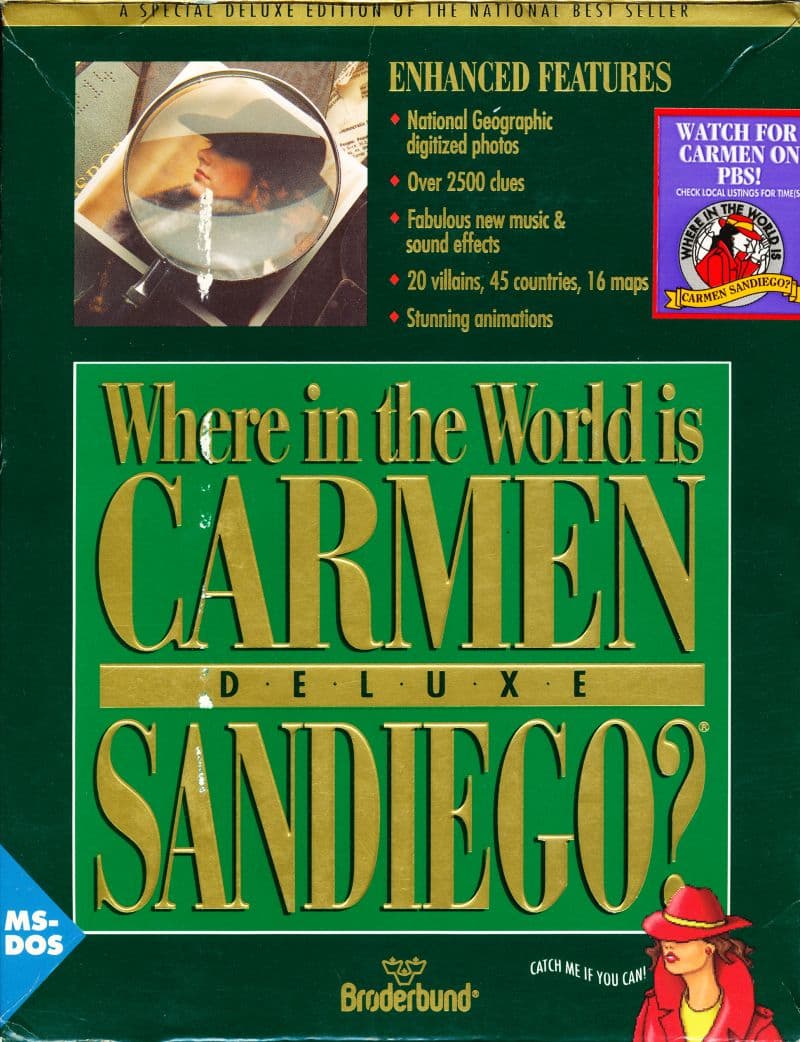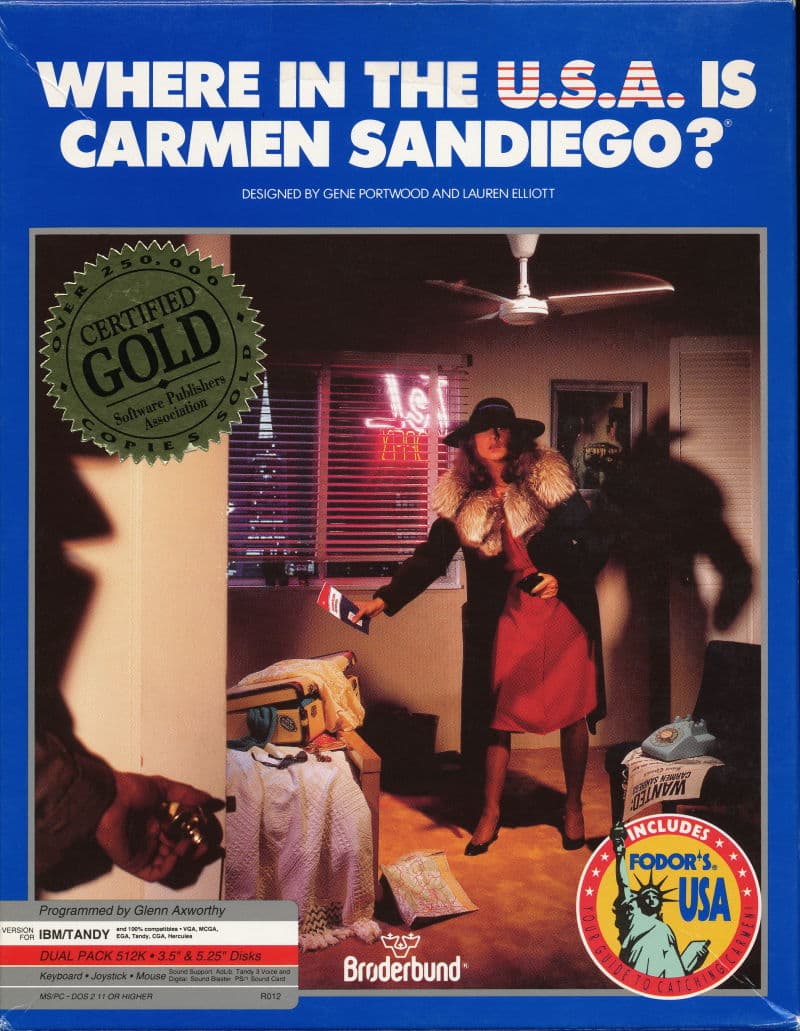
When a V.I.L.E. henchman steals the Statue of Liberty's torch, playing Where in the U.S.A. Is Carmen Sandiego? comes down to parsing clues while frantically flipping through a real paper travel guide before the clock hits zero.
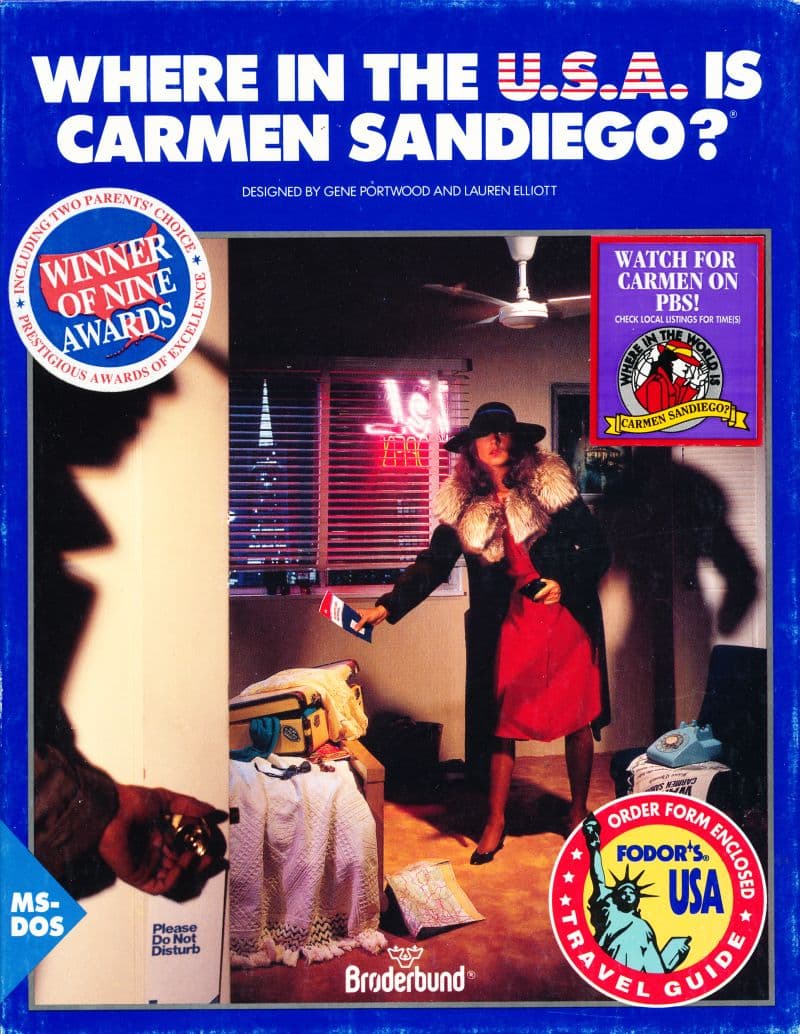
The moment this detective game clicks, you are sitting at an ACME Detective Agency terminal staring at a still-frame view of a city landmark, trying to make sense of what a witness just said. A museum guard tells you the suspect left in a convertible and was asking for directions to the nearest copper mine, leaving you with three days of game time to track them down. You open the Fodor's USA travel guide that Brøderbund Software packaged inside the box, scanning index pages while the PC speaker blips out a rudimentary alert sound. It turns an ordinary educational game into an active table top investigation, forcing you to cross-reference real physical paper with what is happening on screen.
Your routine moves across three main actions per stop: visiting locations like police stations or airports, gathering location or physical clues, and feeding traits into the crime computer database. If a witness mentions the suspect had red hair and drove a limousine, you type those details into your dossier system to narrow down suspects like Sven Galli, Gypsy Rose Lasagna, or Mylar Naugahyde. Catching a crook without the proper warrant issued beforehand results in an immediate failure, letting the criminal slip right through your fingers.
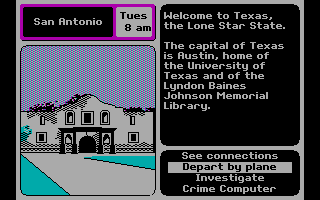
Designers Doug Carlston and David Siefkin took a deliberate approach with this 1986 mystery: never let the player feel like they are sitting through a classroom lecture. Instead of giving you direct quiz questions, the suspects speak in hints about local industries, regional history, or geographic landmarks. Computer Gaming World recognized this strength at release, calling it a valuable tool for building reference book skills and deductive reasoning. You learn state capitals and agricultural exports purely because you need to know which airport to board a plane toward next.
The trade-off for focusing exclusively on American cities was a tighter map compared to its global predecessor, a detail some contemporary reviewers noted. Yet narrowing the scope allowed for far more specific clues, even if the menu-driven system and single-picture representations of cities were limited by mid-eighties disk space. The standard sound hardware support relies entirely on the internal PC speaker, producing simple clicks and beeps that were standard for an MS-DOS game of the mid-1980s.
Longer sessions show just how brutal the timer is. Hours burn away every time you hop between cities or follow up a lead, so one wrong flight booked on a misread hint almost guarantees the crook escapes. Failing an arrest because you forgot to issue the warrant beforehand is an easy blunder that blows a half-hour run.
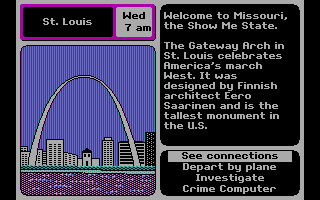
Because of floppy disk storage limits, players who grind up the ACME ranks quickly start seeing the exact same witness lines repeated across cases. The game also lacks smooth difficulty scaling, staying relatively trivial for your first few investigations before suddenly tightening the clock once you reach senior detective status. Desperate players who didn't want to look up facts manually eventually figured out they could open the question.ask text file directly in DOS to read every hint and solution in plain text.
What makes this original release hold up is its complete lack of hand-holding. Modern sleuthing games tend to highlight your next objective on a minimap, but Brøderbund Software expected you to read a hint, think about it, and make a call. The pun-heavy rogues' gallery, featuring criminals like Titus Canby and Sheriff Paul Drive, brings plenty of personality to an otherwise quiet, text-heavy mystery. It is a perfect fit for puzzle fans who like slow-paced deduction and retro computing history.
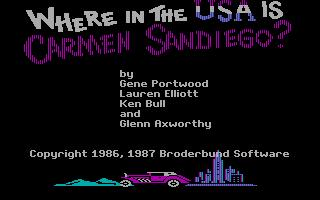
If you want to experience this piece of PC history, you can play Where in the U.S.A. Is Carmen Sandiego? free in your browser right now. Fire up your first case, open a fast tab with an online atlas, and pay close attention to the suspect's hair color before you burn through your travel allowance.

When a V.I.L.E. henchman steals the Statue of Liberty's torch, playing Where in the U.S.A. Is Carmen Sandiego? comes down to parsing clues while frantically flipping through a real paper travel guide before the clock hits zero.
The moment this detective game clicks, you are sitting at an ACME Detective Agency terminal staring at a still-frame view of a city landmark, trying to make sense of what a witness just said. A museum guard tells you the suspect left in a convertible and was asking for directions to the nearest copper mine, leaving you with three days of game time to track them down. You open the Fodor's USA travel guide that Brøderbund Software packaged inside the box, scanning index pages while the PC speaker blips out a rudimentary alert sound. It turns an ordinary educational game into an active table top investigation, forcing you to cross-reference real physical paper with what is happening on screen.
Your routine moves across three main actions per stop: visiting locations like police stations or airports, gathering location or physical clues, and feeding traits into the crime computer database. If a witness mentions the suspect had red hair and drove a limousine, you type those details into your dossier system to narrow down suspects like Sven Galli, Gypsy Rose Lasagna, or Mylar Naugahyde. Catching a crook without the proper warrant issued beforehand results in an immediate failure, letting the criminal slip right through your fingers.

Designers Doug Carlston and David Siefkin took a deliberate approach with this 1986 mystery: never let the player feel like they are sitting through a classroom lecture. Instead of giving you direct quiz questions, the suspects speak in hints about local industries, regional history, or geographic landmarks. Computer Gaming World recognized this strength at release, calling it a valuable tool for building reference book skills and deductive reasoning. You learn state capitals and agricultural exports purely because you need to know which airport to board a plane toward next.
The trade-off for focusing exclusively on American cities was a tighter map compared to its global predecessor, a detail some contemporary reviewers noted. Yet narrowing the scope allowed for far more specific clues, even if the menu-driven system and single-picture representations of cities were limited by mid-eighties disk space. The standard sound hardware support relies entirely on the internal PC speaker, producing simple clicks and beeps that were standard for an MS-DOS game of the mid-1980s.
Longer sessions show just how brutal the timer is. Hours burn away every time you hop between cities or follow up a lead, so one wrong flight booked on a misread hint almost guarantees the crook escapes. Failing an arrest because you forgot to issue the warrant beforehand is an easy blunder that blows a half-hour run.

Because of floppy disk storage limits, players who grind up the ACME ranks quickly start seeing the exact same witness lines repeated across cases. The game also lacks smooth difficulty scaling, staying relatively trivial for your first few investigations before suddenly tightening the clock once you reach senior detective status. Desperate players who didn't want to look up facts manually eventually figured out they could open the question.ask text file directly in DOS to read every hint and solution in plain text.
What makes this original release hold up is its complete lack of hand-holding. Modern sleuthing games tend to highlight your next objective on a minimap, but Brøderbund Software expected you to read a hint, think about it, and make a call. The pun-heavy rogues' gallery, featuring criminals like Titus Canby and Sheriff Paul Drive, brings plenty of personality to an otherwise quiet, text-heavy mystery. It is a perfect fit for puzzle fans who like slow-paced deduction and retro computing history.

If you want to experience this piece of PC history, you can play Where in the U.S.A. Is Carmen Sandiego? free in your browser right now. Fire up your first case, open a fast tab with an online atlas, and pay close attention to the suspect's hair color before you burn through your travel allowance.
The on-screen keyboard and gamepad mapping the browser player uses on a phone, a tablet or a controller, as opposed to the real keys above. $PRO members make their own in the player and share them here; anyone can pick one to play with.
Cheat codes, console commands and memory pokes for Where in the U.S.A. Is Carmen Sandiego? — each one verified and attributed.
Sign in to submitThe on-screen keyboard and gamepad mapping the browser player uses on a phone, a tablet or a controller, as opposed to the real keys above. $PRO members make their own in the player and share them here; anyone can pick one to play with.
Cheat codes, console commands and memory pokes for Where in the U.S.A. Is Carmen Sandiego? — each one verified and attributed.
Sign in to submit
Where in the U.S.A. Is Carmen Sandiego? Deluxe1992