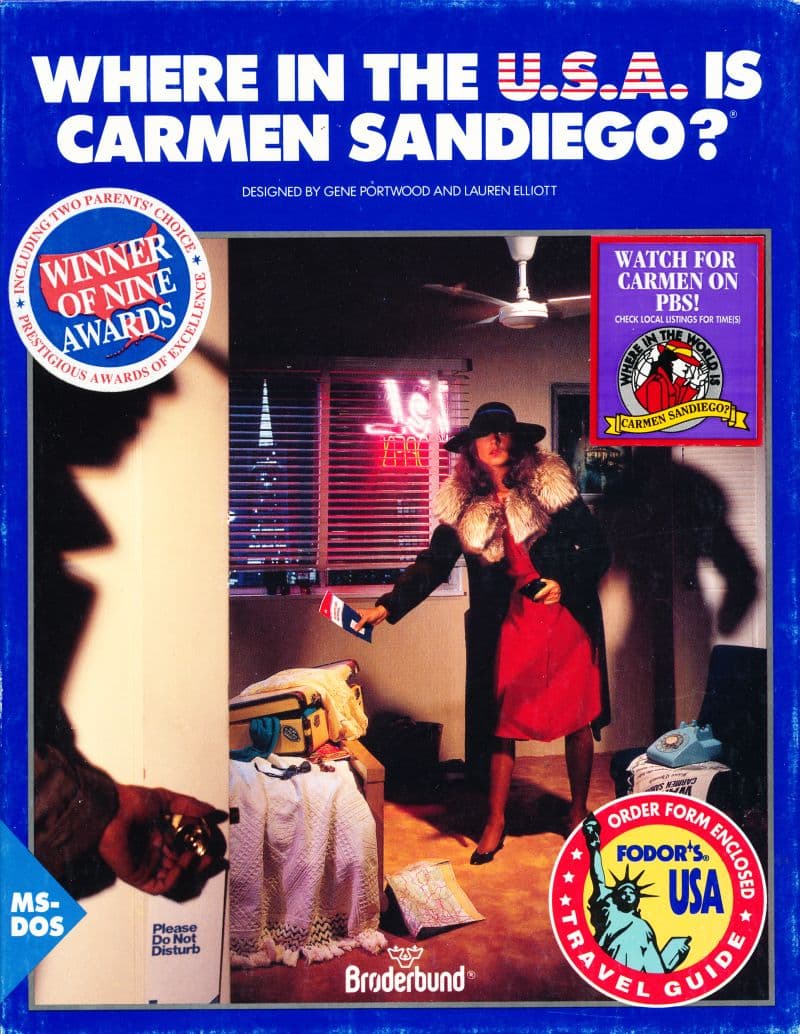
Chasing suspects across fifty states in Where in the U.S.A. is Carmen Sandiego? Enhanced turned geography homework into a race against a ticking clock. Armed with witness testimony and detailed suspect profiles, you fly from city to city trying to log an arrest warrant before your lead turns cold.
Educational titles in the early nineties usually made a quiet trade-off. They either delivered actual coursework under the thinnest layer of interactive paint, or they built a real game that forgot to teach anything substantial. Brøderbund Software, Inc. avoided that trap by building a procedural detective mystery around a simple premise: a thief has looted an American monument, and you have a handful of days to track them down.
The campaign begins with a familiar setup. Carmen Sandiego breaks out of a European prison, crosses the Atlantic, and sends her V.I.L.E. gang out to lift famous national treasures from every corner of the United States. As an ACME rookie, your job is to hop between American cities, question witnesses at regional landmarks, and narrow down both the destination of the suspect and their physical identity. Every destination gives you three places to investigate, like a museum, a harbor, or a library. The information you gather splits directly down the middle. One clue tells you where the suspect went next, while another gives you a personal detail for the arrest warrant.
Witnesses hand out facts about state flags, local industries, historical monuments, and geographical landmarks. If a witness tells you the suspect swapped their cash for gold dust or wanted to visit the site of the First Continental Congress, you have to consult your real-world knowledge or flip through a reference book to figure out the next city. Pick the wrong flight, and you burn precious hours traveling to a dead end while the culprit slips away.
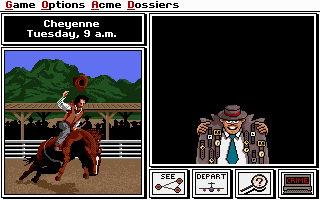
The upgraded release brought full 256-color VGA graphics to the formula, replacing the simpler palette of earlier PC detective titles. Suspects, locations, and crime scenes received crisp illustrations that made browsing through city locations look sharp on PC displays of 1992. Mouse and joystick control simplified clicking through menus, replacing the clunky keyboard entry that dominated older text-heavy mystery games.
Building the warrant requires careful cataloging of suspect traits in the ACME computer database. Every V.I.L.E. henchman has specific characteristics recorded in their profile, including hair color, vehicle of choice, favorite food, hobby, and distinguished features. As you collect clues from witnesses, you input these traits into your dossier machine:
If you arrive at the correct final city without a valid warrant issued specifically for the culprit, you cannot make the arrest even if you find the suspect standing right in front of you. The case collapses, and the thief walks free. To complicate matters further, advancing through the detective ranks brings out the mandatory doc check question. Before accepting a promotion to a higher rank, the game tests you directly with a specific reference query. Fail the check, and your promotion is put on hold until you prove your credentials.
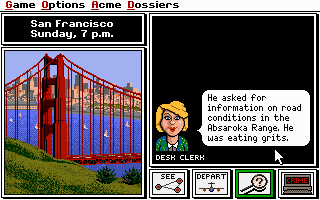
The core tension in this educational game comes from the strict deadline attached to every case. You are given a fixed number of hours to solve the crime. Flying from state to state consumes time, sleeping eats up eight hours every night, and investigating locations takes an hour per attempt. If you waste time chasing a cold lead because you misread a clue about state capitals, the clock will run out before you can secure the warrant and reach the final city.
That constant pressure turns simple trivia lookup into a nervous tactical exercise. When you follow a valid lead, the game rewards you with small animations of V.I.L.E. operatives darting across the screen, confirming you are on the right trail. If you land in a state and the locations yield total silence or confused locals, you immediately know you made a wrong turn. You must backtrack, burning precious travel hours, while trying to recalculate where the thief actually fled.
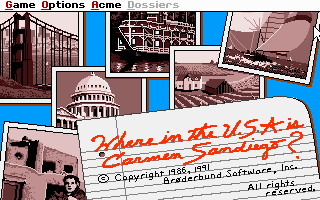
The design does have moments that frustrate. Later cases require extensive trait combinations for obscure henchmen, and if a witness only gives you travel hints without dropping suspect features, you are forced to spend extra hours searching secondary locations just to complete the warrant. Network support allowed multiple players on local connections to log their detective profiles, making it a staple for computer labs and classroom setups where students competed for top rank on the ACME roster.
What makes this release stick in the memory is how efficiently it turned reference material into active play. Stripping away the boring repetition of flashcards, it framed geographic literacy as vital field intelligence. The audio cues on DOS systems, from the PC speaker beeps to Sound Blaster music snippets, gave every captured thief a satisfying crunch of success.
You can play Where in the U.S.A. is Carmen Sandiego? Enhanced online free in your browser right now. You do not need to hunt down vintage disk images or set up custom DOS configurations to start your first assignment. Mouse controls translate perfectly inside modern browser windows, letting you jump straight into the investigator chair, search for clues across fifty states, and test your regional history knowledge today.

Chasing suspects across fifty states in Where in the U.S.A. is Carmen Sandiego? Enhanced turned geography homework into a race against a ticking clock. Armed with witness testimony and detailed suspect profiles, you fly from city to city trying to log an arrest warrant before your lead turns cold.
Educational titles in the early nineties usually made a quiet trade-off. They either delivered actual coursework under the thinnest layer of interactive paint, or they built a real game that forgot to teach anything substantial. Brøderbund Software, Inc. avoided that trap by building a procedural detective mystery around a simple premise: a thief has looted an American monument, and you have a handful of days to track them down.
The campaign begins with a familiar setup. Carmen Sandiego breaks out of a European prison, crosses the Atlantic, and sends her V.I.L.E. gang out to lift famous national treasures from every corner of the United States. As an ACME rookie, your job is to hop between American cities, question witnesses at regional landmarks, and narrow down both the destination of the suspect and their physical identity. Every destination gives you three places to investigate, like a museum, a harbor, or a library. The information you gather splits directly down the middle. One clue tells you where the suspect went next, while another gives you a personal detail for the arrest warrant.
Witnesses hand out facts about state flags, local industries, historical monuments, and geographical landmarks. If a witness tells you the suspect swapped their cash for gold dust or wanted to visit the site of the First Continental Congress, you have to consult your real-world knowledge or flip through a reference book to figure out the next city. Pick the wrong flight, and you burn precious hours traveling to a dead end while the culprit slips away.
The upgraded release brought full 256-color VGA graphics to the formula, replacing the simpler palette of earlier PC detective titles. Suspects, locations, and crime scenes received crisp illustrations that made browsing through city locations look sharp on PC displays of 1992. Mouse and joystick control simplified clicking through menus, replacing the clunky keyboard entry that dominated older text-heavy mystery games.
Building the warrant requires careful cataloging of suspect traits in the ACME computer database. Every V.I.L.E. henchman has specific characteristics recorded in their profile, including hair color, vehicle of choice, favorite food, hobby, and distinguished features. As you collect clues from witnesses, you input these traits into your dossier machine:
If you arrive at the correct final city without a valid warrant issued specifically for the culprit, you cannot make the arrest even if you find the suspect standing right in front of you. The case collapses, and the thief walks free. To complicate matters further, advancing through the detective ranks brings out the mandatory doc check question. Before accepting a promotion to a higher rank, the game tests you directly with a specific reference query. Fail the check, and your promotion is put on hold until you prove your credentials.
The core tension in this educational game comes from the strict deadline attached to every case. You are given a fixed number of hours to solve the crime. Flying from state to state consumes time, sleeping eats up eight hours every night, and investigating locations takes an hour per attempt. If you waste time chasing a cold lead because you misread a clue about state capitals, the clock will run out before you can secure the warrant and reach the final city.
That constant pressure turns simple trivia lookup into a nervous tactical exercise. When you follow a valid lead, the game rewards you with small animations of V.I.L.E. operatives darting across the screen, confirming you are on the right trail. If you land in a state and the locations yield total silence or confused locals, you immediately know you made a wrong turn. You must backtrack, burning precious travel hours, while trying to recalculate where the thief actually fled.
The design does have moments that frustrate. Later cases require extensive trait combinations for obscure henchmen, and if a witness only gives you travel hints without dropping suspect features, you are forced to spend extra hours searching secondary locations just to complete the warrant. Network support allowed multiple players on local connections to log their detective profiles, making it a staple for computer labs and classroom setups where students competed for top rank on the ACME roster.
What makes this release stick in the memory is how efficiently it turned reference material into active play. Stripping away the boring repetition of flashcards, it framed geographic literacy as vital field intelligence. The audio cues on DOS systems, from the PC speaker beeps to Sound Blaster music snippets, gave every captured thief a satisfying crunch of success.
You can play Where in the U.S.A. is Carmen Sandiego? Enhanced online free in your browser right now. You do not need to hunt down vintage disk images or set up custom DOS configurations to start your first assignment. Mouse controls translate perfectly inside modern browser windows, letting you jump straight into the investigator chair, search for clues across fifty states, and test your regional history knowledge today.

How Where in the U.S.A. is Carmen Sandiego? Enhanced is played — the keys the game listens to, grouped by what they do.
Highlighted keys are mapped — hover or tap one to see what it does.
Supports typing for detective sign-in and document checks. Keyboard and joystick input are also supported.
The on-screen keyboard and gamepad mapping the browser player uses on a phone, a tablet or a controller, as opposed to the real keys above. $PRO members make their own in the player and share them here; anyone can pick one to play with.
Cheat codes, console commands and memory pokes for Where in the U.S.A. is Carmen Sandiego? Enhanced — each one verified and attributed.
Sign in to submitHow Where in the U.S.A. is Carmen Sandiego? Enhanced is played — the keys the game listens to, grouped by what they do.
Highlighted keys are mapped — hover or tap one to see what it does.
Supports typing for detective sign-in and document checks. Keyboard and joystick input are also supported.
The on-screen keyboard and gamepad mapping the browser player uses on a phone, a tablet or a controller, as opposed to the real keys above. $PRO members make their own in the player and share them here; anyone can pick one to play with.
Cheat codes, console commands and memory pokes for Where in the U.S.A. is Carmen Sandiego? Enhanced — each one verified and attributed.
Sign in to submit
Where in the U.S.A. Is Carmen Sandiego? Deluxe1992
Where in the U.S.A. is Carmen Sandiego? Enhanced1992 · this page
Where in the U.S.A. Is Carmen Sandiego? Deluxe1992
Where in the U.S.A. is Carmen Sandiego? Enhanced1992 · this page