
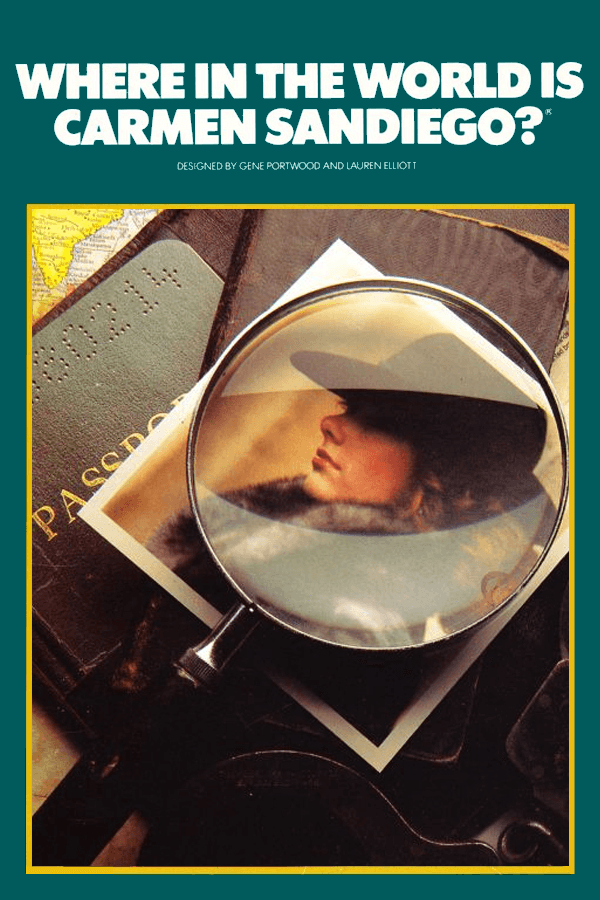

Tracking suspects in Where in the World Is Carmen Sandiego? meant swapping text parsers for point-and-click menus while keeping a massive paper almanac open beside your keyboard.
Designers Gene Portwood, Lauren Elliott, and Dane Bigham built the original 1985 release to replace the grueling typing of early text adventures like Colossal Cave Adventure with clean, menu-driven choices. Instead of wrestling with a parser to inspect a room, you click through options to question witnesses, investigate landmarks, or board a flight. The result felt less like a classroom quiz and more like an actual police investigation, even if its main educational trick was forcing you to thumb through a physical copy of The World Almanac and Book of Facts included inside the box.
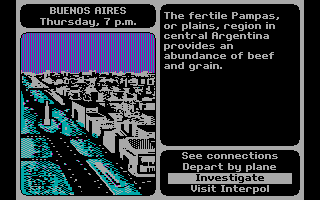
You start your career as a rookie detective at the ACME Detective Agency, tasked with recovering stolen national treasures taken by agents of V.I.L.E., a criminal syndicate run by Carmen Sandiego herself. Every case drops you in a city with a clock ticking down against a strict weekly deadline. Moving between any of the 30 global locations costs precious hours, and flying in the wrong direction quickly drains your remaining time.
That time pressure turns travel into a calculated risk. The flight paths in this early MS-DOS build do not account for time zones or actual global geometry. The game treats world movement as a flat map where flying west takes the long way around, costing hours you cannot afford to waste. If you jump to London before confirming your suspect actually went there, you lose half a day, bringing the criminal one step closer to clean getaway.
Every assignment breaks down into two parallel jobs: tracking the thief's destination and compiling an arrest warrant. Witnesses at the airport, hotel, or embassy drop subtle hints about where the suspect went next, describing flag colors, local currency, or geographic features. If a witness mentions the suspect exchanged their money for pesos or asked about a city near the Andes, you look up those details in the physical almanac to pinpoint the correct flight route.
At the same time, you have to collect physical traits to feed into the ACME computer. Clues will mention the suspect's hair color, vehicle, hobby, or favorite ring. Entering these traits into the computer filters down the database until it outputs a valid arrest warrant. Catching a thief without a warrant results in the case getting thrown out, wasting your entire run even if you tracked them to the correct location.
As you solve cases, Brøderbund Software, Inc. promotes you through the ranks, climbing from Rookie up to Ace Detective before finally getting a crack at Carmen Sandiego. The higher ranks reduce your available time and force sharper deductions. However, the game relies on a limited pool of city clues. During a single long playing session, you will start seeing the same witness dialogue repeat, which strips away some of the mystery once you memorize which clues match which destination.
Running the 1985 MS-DOS version on early PC hardware came with distinct visual and audio compromises. The game was designed for CGA displays using composite graphics mode, resulting in four-color palettes that made locations look crude compared to later VGA remakes. Still, the static graphic stills gave each city a distinct look, showing famous landmarks alongside the location menus.
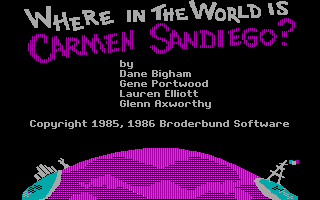
Sound design was equally primitive, piped entirely through the internal IBM PC speaker. Every menu selection, travel transition, and crime scene chime produces a series of sharp single-tone bleeps. There were no digitized sound effects or orchestral themes, just the harsh buzz of early system audio signaling whether you made the right move or ran out of time.
The original save file system also introduced an odd hurdle for players competing for high scores. The in-game Hall of Fame cannot be viewed directly through the playing interface. To see who held the top ranks or clear out old entries, you had to exit to DOS and open the hallfame.dat file inside a standalone text editor. Furthermore, once a detective name was logged, the game prevented you from re-using that same name on a fresh career run.
This 1985 release plays as a surprisingly tight puzzle game, even if its small clue pool and flat flight logic show their age quickly. Strict time management, geographic lookup, and warrant building fit together into a loop that rewarded quick thinking and real-world research. Later Deluxe editions expanded the graphics and audio, but this original version has the exact layout that launched a massive edutainment franchise. If you like retro strategy or menu-driven deduction, play a round of this educational game tonight.
You can play Where in the World Is Carmen Sandiego? free in your browser right now with no setup required. When you start your first case, open the ACME computer terminal early to log your first suspect detail, then cross-reference your destination clues immediately so you do not burn your flight budget on a bad guess.

Tracking suspects in Where in the World Is Carmen Sandiego? meant swapping text parsers for point-and-click menus while keeping a massive paper almanac open beside your keyboard.
Designers Gene Portwood, Lauren Elliott, and Dane Bigham built the original 1985 release to replace the grueling typing of early text adventures like Colossal Cave Adventure with clean, menu-driven choices. Instead of wrestling with a parser to inspect a room, you click through options to question witnesses, investigate landmarks, or board a flight. The result felt less like a classroom quiz and more like an actual police investigation, even if its main educational trick was forcing you to thumb through a physical copy of The World Almanac and Book of Facts included inside the box.
You start your career as a rookie detective at the ACME Detective Agency, tasked with recovering stolen national treasures taken by agents of V.I.L.E., a criminal syndicate run by Carmen Sandiego herself. Every case drops you in a city with a clock ticking down against a strict weekly deadline. Moving between any of the 30 global locations costs precious hours, and flying in the wrong direction quickly drains your remaining time.
That time pressure turns travel into a calculated risk. The flight paths in this early MS-DOS build do not account for time zones or actual global geometry. The game treats world movement as a flat map where flying west takes the long way around, costing hours you cannot afford to waste. If you jump to London before confirming your suspect actually went there, you lose half a day, bringing the criminal one step closer to clean getaway.
Every assignment breaks down into two parallel jobs: tracking the thief's destination and compiling an arrest warrant. Witnesses at the airport, hotel, or embassy drop subtle hints about where the suspect went next, describing flag colors, local currency, or geographic features. If a witness mentions the suspect exchanged their money for pesos or asked about a city near the Andes, you look up those details in the physical almanac to pinpoint the correct flight route.
At the same time, you have to collect physical traits to feed into the ACME computer. Clues will mention the suspect's hair color, vehicle, hobby, or favorite ring. Entering these traits into the computer filters down the database until it outputs a valid arrest warrant. Catching a thief without a warrant results in the case getting thrown out, wasting your entire run even if you tracked them to the correct location.
As you solve cases, Brøderbund Software, Inc. promotes you through the ranks, climbing from Rookie up to Ace Detective before finally getting a crack at Carmen Sandiego. The higher ranks reduce your available time and force sharper deductions. However, the game relies on a limited pool of city clues. During a single long playing session, you will start seeing the same witness dialogue repeat, which strips away some of the mystery once you memorize which clues match which destination.
Running the 1985 MS-DOS version on early PC hardware came with distinct visual and audio compromises. The game was designed for CGA displays using composite graphics mode, resulting in four-color palettes that made locations look crude compared to later VGA remakes. Still, the static graphic stills gave each city a distinct look, showing famous landmarks alongside the location menus.
Sound design was equally primitive, piped entirely through the internal IBM PC speaker. Every menu selection, travel transition, and crime scene chime produces a series of sharp single-tone bleeps. There were no digitized sound effects or orchestral themes, just the harsh buzz of early system audio signaling whether you made the right move or ran out of time.
The original save file system also introduced an odd hurdle for players competing for high scores. The in-game Hall of Fame cannot be viewed directly through the playing interface. To see who held the top ranks or clear out old entries, you had to exit to DOS and open the hallfame.dat file inside a standalone text editor. Furthermore, once a detective name was logged, the game prevented you from re-using that same name on a fresh career run.
This 1985 release plays as a surprisingly tight puzzle game, even if its small clue pool and flat flight logic show their age quickly. Strict time management, geographic lookup, and warrant building fit together into a loop that rewarded quick thinking and real-world research. Later Deluxe editions expanded the graphics and audio, but this original version has the exact layout that launched a massive edutainment franchise. If you like retro strategy or menu-driven deduction, play a round of this educational game tonight.
You can play Where in the World Is Carmen Sandiego? free in your browser right now with no setup required. When you start your first case, open the ACME computer terminal early to log your first suspect detail, then cross-reference your destination clues immediately so you do not burn your flight budget on a bad guess.
How Where in the World Is Carmen Sandiego? is played — the keys the game listens to, grouped by what they do.
Highlighted keys are mapped — hover or tap one to see what it does.
Specific key bindings for gameplay menus were not detailed in available documentation. Hercules adapter users must type 'Carmen Here' at startup.
The on-screen keyboard and gamepad mapping the browser player uses on a phone, a tablet or a controller, as opposed to the real keys above. $PRO members make their own in the player and share them here; anyone can pick one to play with.
Cheat codes, console commands and memory pokes for Where in the World Is Carmen Sandiego? — each one verified and attributed.
Sign in to submitHow Where in the World Is Carmen Sandiego? is played — the keys the game listens to, grouped by what they do.
Highlighted keys are mapped — hover or tap one to see what it does.
Specific key bindings for gameplay menus were not detailed in available documentation. Hercules adapter users must type 'Carmen Here' at startup.
The on-screen keyboard and gamepad mapping the browser player uses on a phone, a tablet or a controller, as opposed to the real keys above. $PRO members make their own in the player and share them here; anyone can pick one to play with.
Cheat codes, console commands and memory pokes for Where in the World Is Carmen Sandiego? — each one verified and attributed.
Sign in to submit
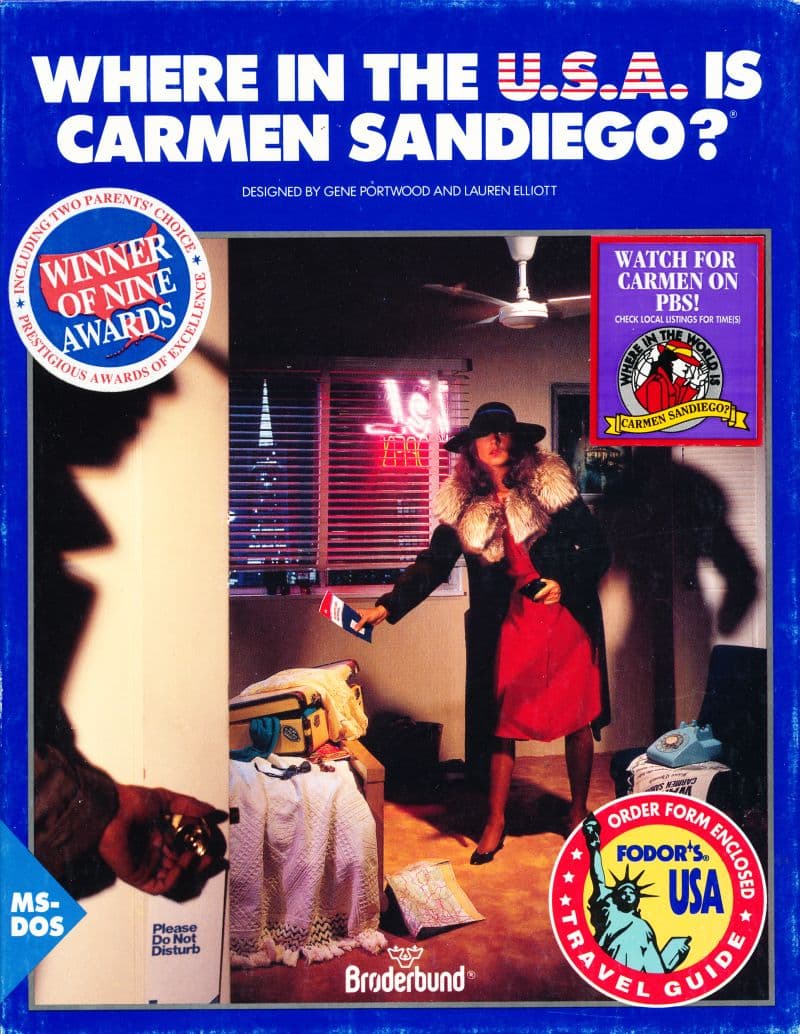
Where in the U.S.A. Is Carmen Sandiego? Deluxe1992